Rechercher dans ce blog

Kamis, 01 Oktober 2020

For Voters Still Mulling, One Thing Is Clear: That Debate Didn’t Help - The New York Times

tebagbagasi.blogspot.com

“Useless.” “Ridiculous.” “Horrible.”

Undecided voters approached the first presidential debate between President Trump and Joseph R. Biden Jr. with some hope of hearing policies and plans that could help them make a decision they had been mulling for months.

Instead, they listened with a mix of disgust and dismay, appalled by the name-calling and lack of decorum of a debate that seemed to shatter any remaining belief that political norms might prevail in a national moment that is anything but normal.

“They seemed like little kids arguing. Or maybe old guys arguing in a diner somewhere. Maybe that’s where they belong — in some diner arguing, not on the national stage,” said Ellen Christenson, 69, of Stevens Point, Wis. “I am just so disappointed in the evening. I don’t have any more information than when I started watching.”

Ms. Christenson said she leaned Democratic, but was undecided this election. Before the debate, she was considering voting for Mr. Trump.

“It was really kind of useless to the American people. I am just sort of disgusted,” she said. “I don’t feel like voting for either of them really, but especially the president.”

For voters battered by a public health crisis that has upended their lives for months and struggling through an economic recession, the debate seemed disconnected from their daily struggles. With hundreds of thousands of people applying for jobless benefits every week and more than 206,000 killed by the coronavirus, the debate became just one more stressor in a country already feeling on edge.

A majority of Americans say they believe the nation’s politics are deeply dysfunctional, framing the election in starkly existential terms. Most say they think the contest will decide whether the United States will remain a prosperous democracy, a view that cuts across age, gender, race, region and ideology.

Tuesday night’s debate only exacerbated those fears. In the highest-profile moment of the highly charged campaign, the candidates presented insults and interruptions rather than plans to help a fearful and anxious country emerge from a period of national crisis.

Neither man detailed proposals for managing a pandemic still roiling the economy, education and daily life. Mr. Trump left voters with little indication of what he might do if re-elected beyond fiercely attack his opponents. And Mr. Biden, who often struggled to complete a sentence because of interruptions from his rival, didn’t dive into the specifics of his plans beyond promising a greater respect for scientists and public health experts.

“I didn’t hear anything that would impact people like me,” said Merrill Tufts, 51, of Winterville, N.C., who is leaning toward backing Mr. Biden. “I see people who have had their small businesses that have had to close. We’re just making it day by day.”

Mr. Tufts, a retired Marine who describes himself as a Democrat with some conservative views and what he called Christian values, said Mr. Trump’s performance compelled him to condemn the president’s behavior to his teenage sons as the family watched the debate.

“I had to tell them: ‘This is not fine. This is not what I expect from you,’” he said. “It was just out of control from jump street. You can smile, smirk, whatever you want, but you can’t just shout down constantly.”

Tim Beck, 68, said he couldn’t sleep after watching the debate, saying the complete lack of decorum left him shaken and questioning his support of Mr. Trump.

Mr. Beck, a retired insurance industry executive from Grand Junction, Mich., voted Libertarian in 2016 because he thought Mr. Trump “was just too whacked out.”

But the last four years have converted Mr. Beck into a backer of Mr. Trump — until Tuesday night’s debate. Now, he’s taking a second look at the Libertarian candidate, Jo Jorgensen.

“I’ve always been a conservative, but I have never seen such an appalling spectacle,” he said. “I have to try to transcend the personalities, like Trump’s nasty, narcissistic personality, and look at actual policies.”

Credit...Gabriela Bhaskar for The New York Times

In Alliance, Ohio, where Mr. Biden spoke Wednesday as part of his whistle-stop train tour through the region, supporters of both presidential candidates lined up across from the train station, seeking to drown each other out with their chants. But at least a few of the Ohioans in attendance, from opposite sides of the aisle, were in agreement on the ugliness of the debate the night before.

“Did you watch the thing last night?” demanded Joan Boyce, 82, when asked why she was backing Mr. Biden. “Then you know why.”

Larry Johnson, 73, stood a few feet away, observing the most vocal Trump supporters. He, too, was disillusioned by the tenor of the debate, though he said he would probably support the president.

“Embarrassing for the country,” he said. “They were both rude.”

Still, he shrugged, “Things have been rude forever.”

Amid a deeply polarized electorate and with voting already underway in states across the country, undecided voters comprise only a small slice of the electorate. In a New York Times/Siena College survey released on Sunday, just 10 percent of likely voters didn’t express a vote preference or said they favored a third-party candidate.

Yet, even in the midst of the most extraordinary circumstances, successful presidential campaigns are always a balance of persuasion and mobilization. In swing states such as Arizona, Pennsylvania and Wisconsin, where the contest is likely to come down to a couple of percentage points, there is a small number of critical voters yet to make up their minds.

For Mr. Trump, who has trailed in polls for months, the matchup was his biggest opportunity to win back support in those crucial battleground states. The president has struggled to recapture parts of his 2016 coalition that have drifted away, particularly older voters and white women.

The president struck an aggressive position, aiming to unnerve Mr. Biden and push a politician who has called himself a “gaffe machine" into a misstep.

Instead, Mr. Trump unsettled voters, including some who supported his outsider candidacy four years ago.

“Almost every word that came out his mouth made me cringe,” said Robert Adshead, 62, a criminal defense lawyer and registered Republican from Abington, Pa. “I was shocked at his behavior.”

Mr. Trump interrupted 741 times, according to the online tracker Factbase feed, striking a combative position even with Chris Wallace, the moderator of the event. He attacked Mr. Biden’s son Hunter in deeply personal terms by raising his struggles with drug addiction.

The president’s effort to play offense quickly became offensive, said Mr. Adshead, who voted for Mr. Trump in 2016 but after watching the debate said he had firmly decided to vote for a Democratic presidential candidate for the first time in his life.

Some of the voters who are sticking with the president were also displeased.

“Trump could have taken the high road and not brought up Hunter Biden’s addiction,” said Dyann Harp, 64, a nurse from Waukesha, Wis., who says she is a longtime Republican and supports Mr. Trump.

Mr. Biden, said Ms. Harp, handled the personal attack “as well as any parent could have.”

Democrats voiced little objection to the insults hurled by Mr. Biden. Throughout the evening, Mr. Biden called his opponent a “clown,” “fool,” “liar,” “racist” and the “the worst president America has ever had.”

Joanne Barnes, 66, a retired autoworker from the Detroit suburb of Auburn Hills, said she thought some of the name-calling might have crossed a line, but that was not stopping her from supporting Mr. Biden.

“The debate was ridiculous,” she said. “We need somebody who respects our country, who respects the rules. If you can’t respect the rules, then how in the world can you run our country?”

Reporting was contributed by Kay Nolan, Jon Hurdle, Kathleen Gray, Isabella Grullón Paz, Maggie Astor and Matt Stevens.

Let's block ads! (Why?)


"that" - Google News
October 01, 2020 at 08:14AM
https://ift.tt/3cMOinB

For Voters Still Mulling, One Thing Is Clear: That Debate Didn’t Help - The New York Times
"that" - Google News
https://ift.tt/3d8Dlvv

Post Office Worries Could Push Voters Back To Polling Places - NPR

tebagbagasi.blogspot.com

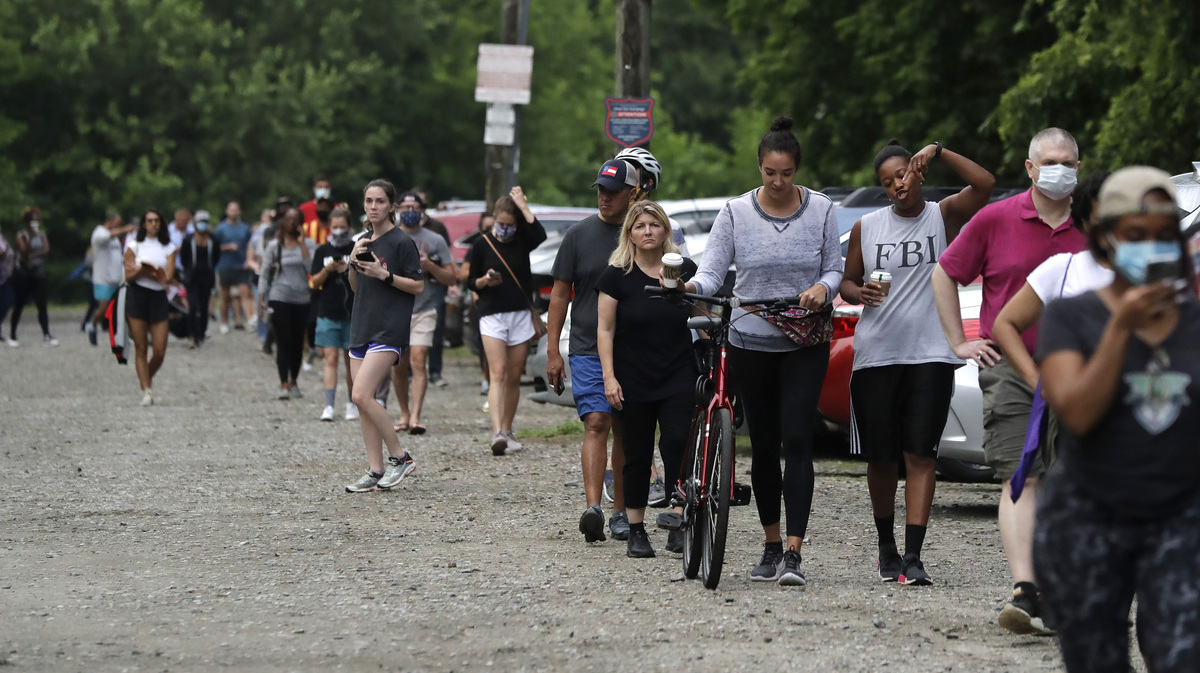
People wait in line to vote in Georgia's June 9 primary election at Park Tavern in Atlanta. Brynn Anderson/AP

Brynn Anderson/AP

COVID-19 is still spreading across the U.S., but you would barely know it by how people are planning to vote this year.

As the pandemic took hold in the spring, voting experts predicted a national shift toward mail or absentee voting: some experts predicted as many as 70% of all votes cast could be by mail, as was the case in Wisconsin's April primary.

But over the past few months, fears about the Postal Service's reliability as well as President Trump's constant railing against mail voting security have meant fewer and fewer people planning to use the method to vote — to the point that officials now worry there may be such a crush of people who want to vote on Election Day, it could lead to unsafe crowding and excessively long lines.

Both a recent NPR/PBS NewsHour/Marist poll and a Citizen Data poll found that just 35% of Americans now say they plan to vote by mail this fall. And half of all voters instead specifically plan to vote in-person on Election Day, according to the NPR/PBS NewsHour/Marist poll.

Loading...

"This is swinging the pendulum back too far," said Tammy Patrick, a former Arizona election official and a senior adviser at the Democracy Fund who has been among the leading national advocates for expanding mail voting options this year. "It breaks my heart, but it does not surprise me."

Jurisdictions across the country are having to consolidate polling precincts due to social distancing guidelines and a lack of available poll workers. In many cases officials have also been banking on a higher number of voters using the mail this year to "flatten the curve" of voters all trying to cast ballots at the same time in the same place.

If that doesn't happen, Patrick said, there could be major problems.

"If we flood our in-person voting facilities, in the middle of a global pandemic," she said, "that is the recipe for some true chaos."

Different reasons, same result

Early polls in the spring showed broad bipartisan support for voting by mail with almost three out of four Americans favoring universal access to absentee ballots, according to an April Pew Research poll.

But then the assault from President Trump and his administration began.

Trump seemed to allude to higher turnout elections favoring Democrats. He and Attorney General William Barr began regularly bringing up conspiracy theories about mail ballot fraud.

"Mail-In Ballots will lead to massive electoral fraud and a rigged 2020 Election," Trump tweeted in July.

Republican voters got the message. By mid-August, just 11% of Trump supporters said they planned to use the mail to vote and it looked like Democrats would anchor the mail voting expansion.

But then the spotlight turned to Postmaster General Louis DeJoy and reports of massive postal delays. A series of high-profile congressional hearings and accusations by Congressional Democrats about those delays led to fears that election mail would be a casualty.

In introducing a bill that would block the U.S. Postal Service from making operational changes, House Speaker Nancy Pelosi, D-Calif., said Trump was instituting a "campaign to sabotage the election by manipulating the Postal Service to disenfranchise voters."

During the Democrats' convention in August, former first lady Michelle Obama told voters, "We have got to grab our comfortable shoes, put on our masks, pack a brown bag dinner and maybe breakfast too, because we've got to be willing to stand in line all night if we have to."

Those sorts of accusations seem to have had an effect on Democratic voters.

Half of Democrats nationally still say they plan to vote-by-mail according to the NPR/Newshour/Marist poll, but that is down from the more than 60% of Democrats who said they were likely to vote by mail in an NPR/PBS Newshour/Marist poll earlier in the summer.

Specifically, the poll from this month also found that non-white voters were much more likely than white voters, 57% to 41%, to have doubts that the USPS will deliver election mail to voters and officials on time this year.

Doubts about the Postal Service are reasonable, considering the widely reported delays, says Dr. Gretchen Macht, an engineering professor who leads the URI Votes group at the University of Rhode Island, but they also could mean crowding on Election Day.

"For the average voter, [voting in person] is tried and true: 'I know that my vote will count. I know when I get there, I will just wait in line and I will just do it,'" Macht said. "But for somebody who studies voting, you're like, 'No, no, no, no, no, no, no! The system can't handle all of you showing up!'"

Modeling differences

Predicting election turnout, and specifically voter behavior, is notoriously difficult.

It's still possible that the number of voters who end up using the mail to cast a ballot is higher than the recent polls indicate. Projections by the nonpartisan data firm Citizen Data even indicate that scenario is likely.

The firm says it's projections take into account the recent polling data, but also real voting behavior, like ballot requests and vote history, according to Citizen's COO, Mindy Finn.

The company's projections show 50% of likely Florida voters voting by mail this year for instance, compared with 38% of likely Florida voters who responded in the company's poll saying they intended to vote-by-mail.

The disparity may be explained by voters not taking into account the relative ease of voting by mail, the company says. Voters who respond in polling that they don't plan to vote by mail may change their mind if they receive a ballot or ballot request form in the mail.

The firm also notes that their projections show a smaller partisan divide between Republicans and Democrats on whether they expect to vote by mail.

"We're seeing high levels of intent to vote by mail from survey respondents nationwide, but in key states, our modeled projections are even higher," said Rebecca Coffman, Citizen's COO. "Of course, the landscape is incredibly dynamic. Some voters who say they don't plan to vote by mail may not have received a mail ballot yet, for example."

The company's data shows similar differences between their projections and the poll responses in other battlegrounds like Wisconsin and Michigan.

All this has local election administrators doing their best to guess how their voters will vote this year.

Brianna Lennon, the county clerk of Boone County, Mo., said she started to sense a shift from voters away from the mail during Missouri's August primary.

"What we started to see in August, was people who requested an absentee ballot, had it mailed to them, and then said 'ah I want to go to the polling place,'" Lennon said.

When she does public events, she says the most popular question she gets is whether the mail is a safe way to vote, and whether a vote will be counted if it's cast using the mail. It doesn't help, Lennon said, that voters are being barraged with news about the dozens of pending lawsuits nationwide related to mail voting rules.

"They're seeing Post Office stuff and they're getting nervous, they're seeing litigation and they're getting nervous," Lennon said. "And they want to switch."

Patrick of the Democracy Fund said she wishes those nervous voters would react by sending their ballot in earlier, giving the Postal Service time to work, and not by abandoning the mail altogether.

Lennon is still expecting a big bump in the number of ballots in Boone County that come back through the mail, compared to 2016, when only about 7% of voters voted that way. But she's not sure it'll now be big enough to mean there won't be long lines at some of the precincts in her jurisdiction.

"I would like November to be something like 30% [by mail], because I think that that will help alleviate congestion at the polling places," Lennon said. "But I don't know right now whether we're going to get there or not."

Let's block ads! (Why?)


"that" - Google News
October 01, 2020 at 04:00PM
https://ift.tt/33i0zwS

Post Office Worries Could Push Voters Back To Polling Places - NPR
"that" - Google News
https://ift.tt/3d8Dlvv

Search

Entri yang Diunggulkan

Miami cruise passengers arrested after more than 100 bags of marijuana found in luggage - WPLG Local 10

MIAMI-DADE COUNTY, Fla. – Federal agents say they busted a pair of travelers, who tried to take a cruise out of PortMiami with very illega...

Postingan Populer